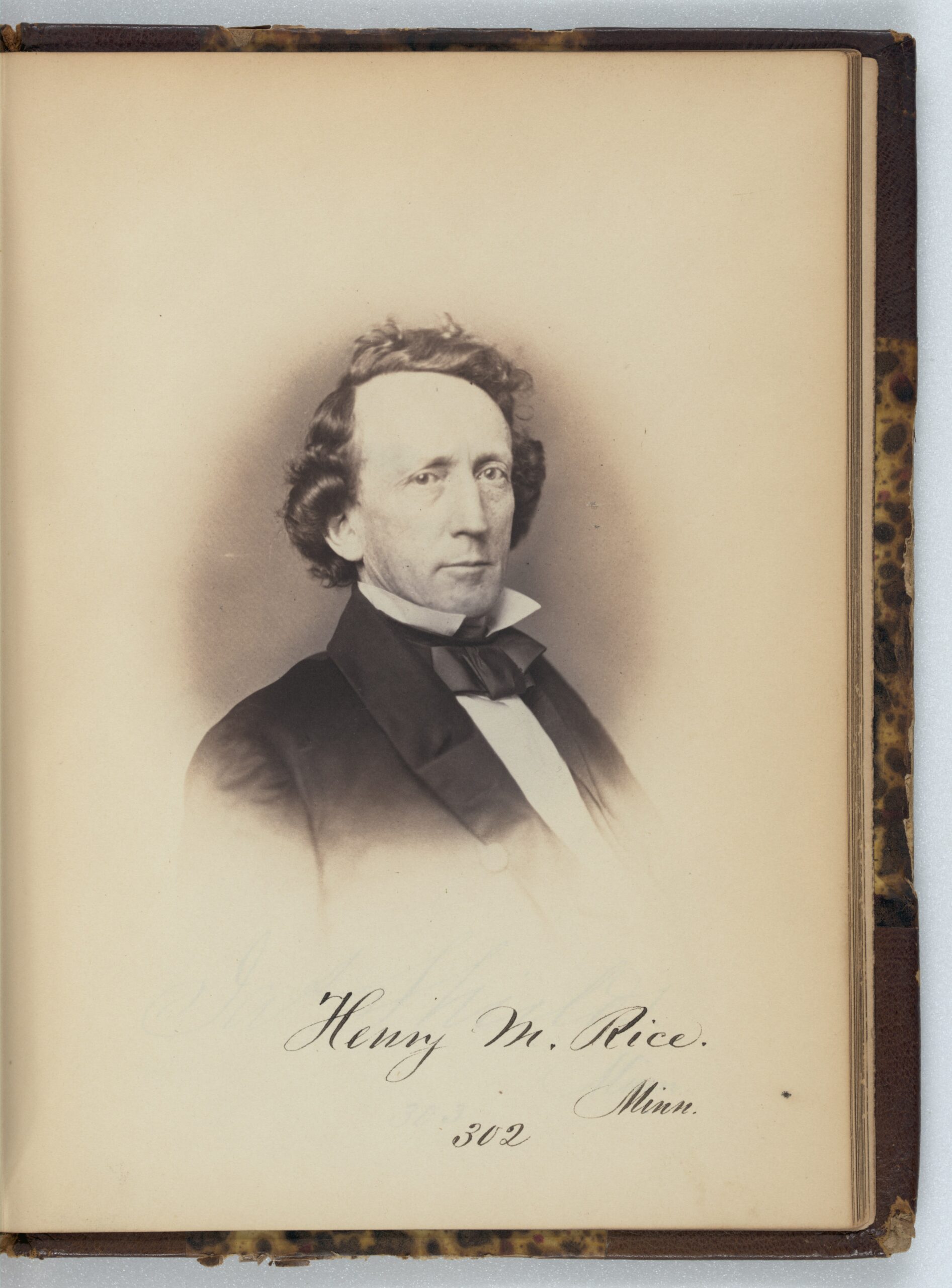
Henry M. Rice helped carry Minnesota to statehood — as a fur trader, territorial delegate, and one of the state’s first U.S. senators. This is the full article in this post, from the fur trade posts of the Upper Mississippi to the halls of Congress, with a places guide below, “Walk Rice’s St. Paul: six places where this story happened.”
Trader, treaty negotiator, territorial delegate, and one of Minnesota’s first two United States senators — Henry Mower Rice helped create the state, and how he did it is also a story about the land and the Native nations who lost it.
Minnesota did not become a state by accident. Before there were ballots, railroads, or a capitol in St. Paul, there were trading posts, river landings, and men who could move between worlds. Henry Mower Rice was the most effective of them.
Born in Vermont in 1816 and at work on the Upper Mississippi by age twenty-three, Rice built his influence first in the fur trade — where trust, credit, and personal relationships mattered more than titles — and then carried that influence to Washington. He lobbied for the creation of Minnesota Territory in 1849, represented it in Congress from 1853 to 1857, wrote the legislation that set statehood in motion, and on May 11, 1858, took his seat as a United States senator on the day Minnesota entered the Union.
That arc — from a Fort Snelling sutler’s store to the Senate — makes Rice indispensable to understanding early Minnesota. It also makes him impossible to understand honestly without the other half of the record: the treaties he helped negotiate transferred vast Ojibwe, Dakota, and Ho-Chunk lands to the United States and set removal in motion. Both halves belong in the same article, because in Rice’s life they were the same work.
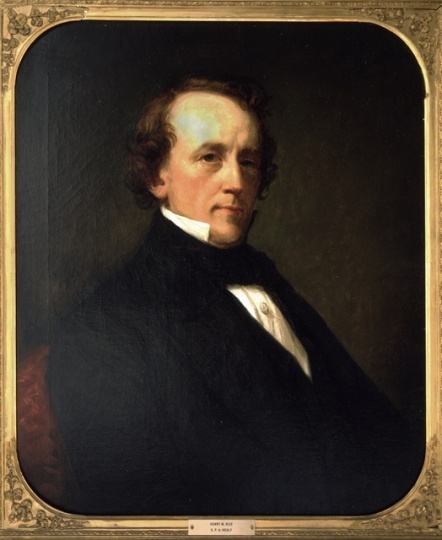
At a glance
- Full name: Henry Mower Rice
- Born: Nov. 29, 1816, Waitsfield, Vermont
- Died: Jan. 15, 1894, San Antonio, Texas; buried Oakland Cemetery, St. Paul
- Party: Democratic
- Delegate: Minnesota Territory, 1853–1857
- Senator: Minnesota, May 11, 1858 – March 3, 1863
- Family: Married Matilda Whitall in March 1849; nine children
Early Life & the Fur Trade
A Vermonter goes west, and learns how power worked on the frontier.
Henry Rice was born on November 29, 1816, in Waitsfield, Vermont, to Edmund Rice and Ellen (Durkee) Rice, New Englanders whose ancestors had arrived in the early 1600s. His father died when Henry was young, and he lived from an early age with family friends — a start that helps explain a lifelong pattern of building his own networks rather than inheriting them.
At eighteen he left for Detroit, attended schools and academies there and in Kalamazoo, Michigan, and helped survey a canal route around the rapids at Sault Ste. Marie, between Lake Superior and Lake Huron. It was practical, outdoor, commercial work — exactly the apprenticeship the Great Lakes frontier rewarded.
In 1839 Rice reached Fort Snelling, near present-day Minneapolis, to work in the sutler’s trade — supplying soldiers at the fort — for the American Fur Company, assisting Franklin Steele. In 1842 the company’s regional agents, Henry Sibley and Hercules Dousman, sent him to Fort Atkinson in Iowa Territory as post sutler, where Ho-Chunk (Winnebago) people had been removed from Wisconsin. There, and then among the Ojibwe (Chippewa) in Minnesota, Rice became a trader in his own right.
“Rice was trusted” — the phrase recurs in the early accounts — and on the frontier, trust was a currency that could be spent in Washington.
MNopedia, the Minnesota Historical Society’s encyclopedia, puts the outcome plainly: Rice “quickly grew wealthy through the fur trade and land speculation.” He also learned the languages of negotiation — who could speak for a community, what a promise meant, how goods, credit, and kinship bound a deal together. His contemporaries called the Democratic faction around him the “Moccasin Democrats,” for its roots in the fur trade and Indian Agency contracts. The label was meant as a jab. It was also accurate.
That combination — wealth, relationships with Native leaders, and fluency in federal contracting — is what turned a trader into a political force. When Minnesota needed someone who could argue its case in Washington and its case at a treaty council, Rice was, for a time, the same person doing both.
Treaty Negotiator — Trusted negotiator and agent of land cession and removal
Rice’s trading relationships soon made him useful to the federal government, and he made himself useful to the Ho-Chunk and Ojibwe as an intermediary — roles that could align, and could sharply conflict. In 1846 Ho-Chunk leaders asked him to represent their interests in Washington. He participated, officially or unofficially, in a long sequence of treaties: the 1846 Winnebago treaty in Washington, the 1847 Ojibwe treaties at Fond du Lac and Leech Lake, the 1854 Ojibwe treaty at La Pointe, Wisconsin, and — four decades later, as a United States commissioner in 1887–1888 — further negotiations with the Ojibwe of Minnesota.
The Congressional biography credits Rice’s “personal influence” with securing Dakota consent to confirmation of the 1851 treaties of Traverse des Sioux and Mendota, by which, in its words, “all of Minnesota west of the Mississippi River and south of Ojibway County was opened to white settlers.” Read from the other side, those same treaties — and the 1847 cessions intended in part as land for removed tribes — dispossessed Dakota and Ojibwe communities on a massive scale.
Rice also helped organize the Ho-Chunk removal from the Neutral Ground in Iowa in 1848 and took a federal contract in 1850 to remove Ho-Chunk people who had not gone to Long Prairie or had scattered from it. He selected land at Long Prairie where, MNopedia notes, he had just acquired rights to control the trade — a detail that captures how public duty and private interest were intertwined in his treaty work.
A modern reader does not have to choose between calling Rice a trusted negotiator and calling him an architect of dispossession. The sources support both descriptions of the same career, and holding them together is what separates history from commemoration.
A note on names: Sources of Rice’s era use Winnebago for the Ho-Chunk and Chippewa or Sioux for the Ojibwe and Dakota. This article uses Ho-Chunk, Ojibwe, and Dakota, with the older terms noted where a treaty or source title requires them.
Delegate & Senator
He lobbied Minnesota Territory into existence, then wrote its path to statehood.
Rice settled in St. Paul in 1848 and lobbied for the bill that established Minnesota Territory in 1849. From 1849 onward, when he was not in Washington, St. Paul was home: he built warehouses, hotels, and business blocks, helped establish the St. Paul Chamber of Commerce, and invested in land, steamboats, and railroads. He served on the University of Minnesota’s Board of Regents from 1851 to 1859 and was a charter member — and later president — of the Minnesota Historical Society.
In 1853 Rice defeated Whig opponents to succeed Henry Sibley — his former fur-trade partner, by then his political rival — as Minnesota’s territorial delegate. A delegate could speak, bargain, and draft bills, but not vote on final passage, so the job rewarded exactly Rice’s skills. Re-elected in 1855 in a closer race clouded by questions about family and business ties to a railroad deal, he focused, as MNopedia summarizes it, on “facilitating population growth and economic development.”
In 1854 he passed a bill issuing certificates, or “scrip,” exchangeable for 160 acres of unclaimed federal land, to Métis people displaced by the new Dakota treaties. In 1856 he faced a corruption charge over the alleged use of his influence to acquire land; he was not expelled. And in 1857 he authored the Minnesota Enabling Act — passed February 26, 1857 — which authorized Minnesotans to draft a constitution and apply for statehood. Without that act, there is no state in 1858.
In the Senate, through secession and civil war
When Minnesota was admitted on May 11, 1858, the legislature elected Rice and James Shields, both Democrats, of St. Paul, as the state’s first two senators. They took the oath on May 12; both elections were contested, and both men were eventually seated. Rice served through the 35th, 36th, and 37th Congresses, until March 3, 1863, and did not seek re-election in 1862.
Accounts summarized by the Minnesota Historical Society note that Rice had sympathized with Southern arguments over secession before the war, but once fighting began he supported the Union war effort. That ambiguity followed him home. As the Democratic nominee for governor in 1865, he lost to William R. Marshall, in a campaign where convincing voters he had no Confederate sympathies became the central struggle.
Later Life & Legacy
Honored in marble and on the map — and due a fuller reckoning.
Defeat in 1865 ended Rice’s elective career, not his public life. He served as president of St. Paul’s board of public works, as treasurer of Ramsey County from 1878 to 1884, and — in his early seventies — as a United States commissioner for Indian treaties in 1887–1888. He died on January 15, 1894, while visiting San Antonio, Texas, and was buried in Oakland Cemetery in St. Paul.
Minnesota remembered him concretely. Rice County, established March 5, 1853, was named for him while he was still territorial delegate — and Rice presented the county with a political and historical library. Rice Street in St. Paul carries his name as well. A marble statue by Luella A. Varney Serrao was placed in the Minnesota State Capitol in 1906. Then, on February 8, 1916, Congress unveiled a 7-foot, 7-inch marble statue by Frederick E. Triebel in the National Statuary Hall Collection — one of only two statues Minnesota may place there.


The fuller reckoning is now part of the legacy, too. The same Minnesota Historical Society that Rice helped found publishes the MNopedia account documenting both his state-building and the treaty system that displaced Native nations. That is a fitting place for his story to live: not on a pedestal alone, but in an archive open to everyone — where the trader who was trusted, the delegate who delivered statehood, and the negotiator whose treaties changed who could live on the land can all be seen, at once, as one man.
Timeline
- 1816 — Born in Waitsfield, Vermont
- 1839 — Arrives at Fort Snelling
- 1846–47 — Ho-Chunk and Ojibwe treaty work
- 1849 — Minnesota Territory created
- 1853–57 — Territorial delegate
- 1857 — Enabling Act, Feb. 26
- 1858–63 — U.S. Senator
- 1865 — Loses race for governor
- 1894 — Dies in San Antonio
- 1916 — Statue unveiled, Feb. 8
Sources
- Biographical Directory of the United States Congress, “RICE, Henry Mower” (ID: R000198) — https://bioguide.congress.gov/search/bio/R000198
- Minnesota Historical Society, MNopedia, Samuel Meshbesher, “Rice, Henry Mower (1816–1894)” — https://www.mnhs.org/mnopedia/search/index/person/rice-henry-mower-1816-1894
- Architect of the Capitol, “Henry Mower Rice Statue” — https://www.aoc.gov/explore-capitol-campus/art/henry-mower-rice-statue
- U.S. Senate, Minnesota timeline — https://www.senate.gov/states/MN/timeline.shtml
- Warren Upham, Minnesota Geographic Names (1920), on Rice County.
Walk Rice’s St. Paul: six places where this story happened
Rice’s Minnesota is not only in archives. The fort where he arrived in 1839, the park he gave the city in 1849, the statue Minnesotans put in their Capitol, and the cemetery where he is buried are all still standing, most of them within a few miles of each other in St. Paul. Hours change with the seasons, so check the official link for each stop before you go.
At the confluence: where the fur trade happened
1. Historic Fort Snelling

This is where Rice’s story starts. He reached Fort Snelling in 1839, about age twenty-three, to work in the sutler’s trade — supplying soldiers at the fort — for the American Fur Company, assisting Franklin Steele. The restored fort stands at Bdote, the Dakota homeland at the confluence of the Mississippi and Minnesota rivers, and its exhibits now tell the wider history of the place: Native peoples, trade, soldiers and veterans, enslaved people, and immigrants.
200 Tower Ave, St. Paul, MN 55111 · 612-726-1171 · Fall and winter: Thursday–Saturday, 10am–4pm, with the historic fort entered on guided walking tours; summer hours are longer.
Plan a visit at MNHS · Open in maps
2. Sibley Historic Site, Mendota

Across the river from the fort, Mendota was the fur trade’s other headquarters. Henry Hastings Sibley ran the American Fur Company’s regional operation here, and it was Sibley and Hercules Dousman who sent Rice to Fort Atkinson in 1842 — the posting that made him a trader in his own right. Rice later succeeded Sibley, his former partner turned rival, as territorial delegate in 1853. The limestone Sibley House, built in 1835, is the oldest private residence in Minnesota, and Mendota is where the 1851 treaty that bears its name was signed.
1357 Sibley Memorial Hwy, Mendota, MN 55150 · Closed for regular house tours for the season until Memorial Day weekend 2027; grounds open year-round for free walking, and special events continue in winter — check mnhs.org/sibley or 651-452-1596 for current events.
Plan a visit at MNHS · Open in maps
Downtown: the park he gave the city, and the statue in the Capitol
3. Rice Park and Rice Street

In 1849, when Rice and banker John Irvine platted this part of St. Paul, they set aside this block as a public square — one of the two parks in the city’s original plat. It still anchors downtown, ringed by the Landmark Center, the Saint Paul Hotel, the Central Library, and the Ordway Center for the Performing Arts, which is named for Lucius Pond Ordway. From the park, walk north up Rice Street, the working commercial corridor that also carries his name, toward the Capitol.
109 W 4th St, St. Paul, MN 55102 · Free and open daily · The park’s fountain figure, sculptor Alonzo Hauser, was dedicated in 1965.
Rice Park at the City of St. Paul · Open in maps
4. Minnesota State Capitol

The article closes with Triebel’s 1916 statue of Rice in the U.S. Capitol in Washington — but Minnesota kept a Rice statue of its own. Luella A. Varney Serrao’s marble statue of Rice was placed in the State Capitol in 1906, in the Cass Gilbert building where the legislature Rice lobbied into being still meets. Free guided tours cover the building’s history, art, and architecture, and the Rice Street station on the Green Line sits just west of the building.
75 Rev Dr Martin Luther King Jr Blvd, St. Paul, MN 55155 · For tour information: 651-259-3015 · Open Monday–Friday, 8am–4:30pm, and Saturday, 10am–3pm; closed Sundays.
Plan a Capitol visit at MNHS · Open in maps
The archive he helped found, and where the story ends
5. Minnesota History Center

Rice was a charter member of the Minnesota Historical Society and later its president, so it is fitting that the fullest modern account of his life — the MNopedia entry this article draws on — comes from the society he helped start. The History Center holds the society’s museum and the Gale Family Library, where readers can dig into the fur-trade and treaty-era record for themselves.
345 W Kellogg Blvd, St. Paul, MN 55102 · 651-259-3000 · Open Wednesday–Sunday from 10am (11am Sundays), Thursdays until 8pm; closed Mondays and Tuesdays.
Plan a visit at MNHS · Open in maps
6. Oakland Cemetery

Rice died in San Antonio on January 15, 1894, and was brought home to Oakland, St. Paul’s oldest public cemetery, founded in 1853. The cemetery’s own list of notable interments locates him at Map Post E 24, Block 25, Lot 1, and sums up his arc in a line: instrumental in the act that made Minnesota a state, a U.S. senator from 1858 to 1863, donor of Rice Park, and namesake of Rice County. Sibley, Alexander Ramsey, and Norman Kittson are buried here too.
927 Jackson St, St. Paul, MN 55117 · 651-224-2366 · Gates open 8am–8pm in summer and 8am–4:30pm in winter; the grounds sit just east of Rice Street.
Notable interments at Oakland Cemetery · Open in maps
Make a day of it: Pair Fort Snelling’s tour with a winter grounds walk at Sibley, just east of Highway 55 — grounds open year-round for free walking while house tours are closed for the season. Downtown, Rice Park, the Capitol, and the History Center form a walking cluster for the statehood half. Finish at Oakland Cemetery, a few minutes north of downtown.
Place details and photo credits: Addresses, hours, and visiting details are from the Minnesota Historical Society (mnhs.org), the City of St. Paul, Minnesota State Capitol visitor information (mn.gov), and the Oakland Cemetery Association, checked in November 2026; confirm hours on the official link for each stop before visiting. Photos of the six places are from Wikimedia Commons; credits appear under each photograph.